Saturday, March 19, 2011

Magical Ecuador and the Countryside Part II Also a fantastic Giveaway From French Basketeer

Our wonderful lodgings at Hacienda Cuisin, purchased from the King of Spain a year before Cervantes wrote Don Quixote, originally encompassed over 100,000 acres, north of Quito in the lush Andean highlands. At 8,500 feet with the predictable equatorial sun, and rich volcanic soils,  the owner, Nicholas Millhouse has resurrected this old world eden. It is a perfect refuge or staging area to explore the dramatic countryside. 


The beauty of colonial architecture lies within the flow of interior and exterior space. Courtyards and gardens alternate between verdant sanctuaries and cozy firesides. 


Nicholas Millhouse has created a delightfully eclectic mix of English comfort, Andean crafts and ecclesiastical arts. The famed Ecuadorean roses are splashed around every single room, as if they were daisies.  


Orchids and bromeliads bloom profusely in the branches of over 1000 varieties of trees on the estate. The garden is a horizontal and vertical experience. 


Dinner was actually growing in the morning from the Hacienda gardens. I love soup, an unworthy name for my favorite detectible course. The fresh vegetable soups in Ecuador generate swoons. I need to mention the juice. We have never heard the names, or tasted these fruits at our designer grocery stores. I thought every exotic fruit on the planet was within reach---so not true.  The fresh fruit juice is so delicious I could  become diabetic.


Over 60 species of flowers from all over the world are cultivated in the gardens. 


17th century,
horse and carriage trammelled cobblestones, lead us through a door in the wall. Before we pass, into the garden, we are reminded to consider its dynamic opposite.


Our host is an avid collector of textiles from all over the world. If you are a fan (Jane Schott, you know I mean you) you are in for a treat. 


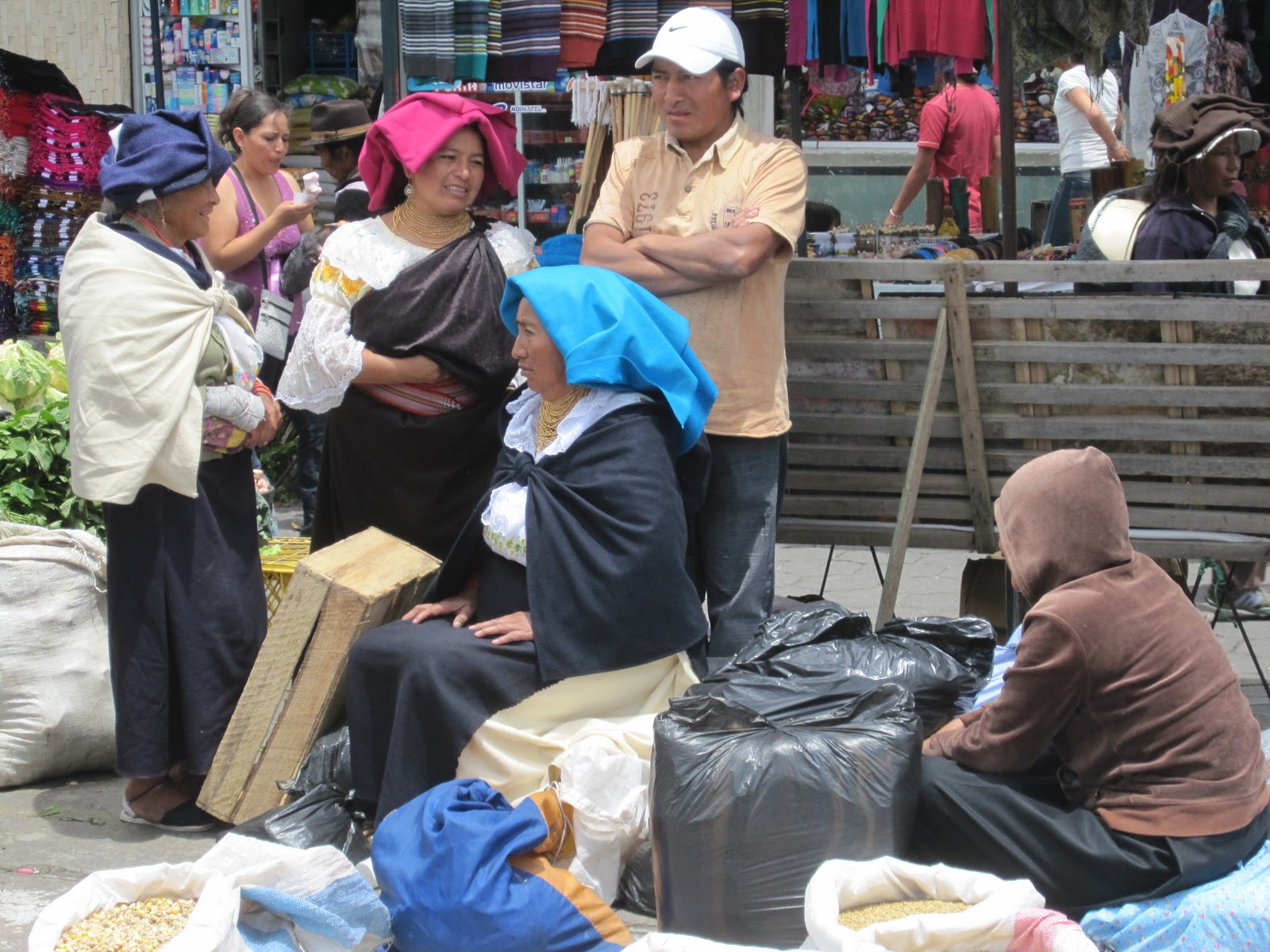
You can write your first novel here, or visit the famed Otavalo craft market, a largely indigenous town in the Imbabura Province of Ecuador. The town, which is in a valley, is surrounded by the peaks of Imbabura 4,630m, Cotacachi 4,995m, and Mojanda volcanoes.


Ramelle Pulitzer of New View Tours, who planned and organized our trip shared this photo.


The people of Otavalo are famous for their sweetness, although I will say, you pass houses with bars on the windows, with walls and gates.  We were firmly instructed to hold on to our wallets, but for once in my life, I had no trouble.


I wanted to give you a bird's eye view of the this dramatic volcanic valley. 

PHOTO SOURCE: Patricio Ramon

Every inch of arable space is feverishly cultivated by the indigenous population. When I tell you these hillsides are steep, I am not kidding. We walked along the brittle edge of the caldera on the right hand side. I had to sit down and make contact with the earth to orient myself.


You can hike around the massive lake, in the eco preserve, formed by an epic volcanic explosion over 3,000 years ago. I know most of you will forgive me if we took the short hike (we were at an altitude of 10,200 feet here), and went shopping in the famous Cotacachi, the center of Ecuador's leather industry, which is known for its polished calf skins. The whole town is bags, shoes, coats etc.. The prices are terrific.


I collided with the fiesta! How adorable are these girls? I missed photographing the attentive nuns coaxing them through their performance.


Ramelle and Michael Pulitzer, our hosts at New View Tours,  introduced us to Miguel Andrango the master traditional weaver


The local flora and some fauna, provide the natural dyes for the hand carded and spun wool.


Miguel spins on the walking loom, made by his father.


The maestro at his craft


Miguel and his daughter Luz Maria stand in front of the beautiful woven textile I purchased. I am humbled by the painstaking dedication to the process of their traditional art. It takes two months to wash, card, spin, dye and weave this remnant of the past.  Our small group was touched by their kindness and patience, describing this dying art.


More lost arts can be found in the workshops of San Antonio de Ibarra.


The upscale Galeria Latina, in Quito, has an astonishing array of the Andean crafts. I lust for a collection of these bad boys!


Andrea of French Basketeer has a generous giveaway for our Readers!

Go to Andrea's website and choose your favorite bag!

Come back to Dovecote Decor and let us know by leaving a comment!

 Come back every time you tweet or share on facebook, and let us know,
it will increase your odds of winning.

Good Luck!!


Friday, March 11, 2011

The Magical Equator: Quito and The Countryside of Ecuador


Photo Courtesy of New View Tours

Last winter I vowed not to endure the dreary months of January and February in North Carolina, so when my friends Ramelle and Michael Pulitzer of New View Tours sent me their itineraries, I jumped on The High Sierra Tour.


There is no way I am going to poke around a third world country on my own, and since the Pulitzers have beaten a path down there for years, joining their group made this adventure possible for me.  Many of our friends have visited the 17th century Hacienda Cusin, our home base down the Pan American highway, an hour outside of Quito. Our host Nik Millhouse celebrated his 21st year of inn keeping with us, and we were dazzled by his extensive knowledge of the area and charmed by his wit and humor. We stayed on the El Monasterio side of the Inn, a short walk through the exotic gardens shared between them. 

Elaborately carved doors into El Monasterio courtyard 


The equator is a bewitching place. At 9,200 feet we are in a verdant paradise where tropical plants grow side by side with English garden flowers of all seasons. 


Above us, are the third closest mountains to the sun, below us are vertiginous ravines and gorges, as if nature had squeezed every aspect of herself into this corner of the world. 


The ancient cultures and rich heritage of the area are derived from this abundance. With three harvests a year, the wealthy, indigenous people had time to calculate complex and highly accurate celestial measurements, knowing well before the Europeans that the earth was round, that they lived in the center of the planet, that the earth tilted at 23.5 degrees (actual 23.45) and that it orbited the sun. 


The Equatorial line passing through the high plateaus and mountains of Ecuador provides a unique place on earth to observe the stars of both hemispheres simultaneously. Solar  sight-line markers were erected over great distances to accurately mark the solar and lunar traverses. Many of Quito's churches were built on top of much earlier, indigenous astrological monuments, lined up along the route of the sun on the summer solstice. The Quitsato Project has more information on this topic. 


I took this photograph of an old door on the Hotel Andaluz in the Colonial heart of the ancient city, conquered by the Spanish from the Incas in 1534. The eight sided star in the center is an archetypal symbol and is believed to have been the basis of locations for indigenous Ecuadorian observatories. The roots of the eight-point star symbol are derived from early astronomy. The eight lines are symbolic of the four corners of space (north, south, east, and west) and time (two solstices and two equinoxes). 


four corners of space and time

This eight sided star is seen throughout the region in textile designs, yet would have been integrated by the Spanish, as moorish architectural motifs. Layers of indigenous, Inca, Spanish, Moorish and French building design co-exist in Quito, much like the rest of the flora, fauna and dramatic geology of the equatorial region. 


The Plaza Simon Bolivar, commemorating the liberator of grand Columbia (Ecuador, Peru, Venezuala and Columbia).  Note the Moorish roof lines. 


Quito was the first city in the world to be named a UNESCO heritage site. On the left you can catch a glimpse of the presidential palace. On the corner, the bizarre Chilean Auricaria tree towers above the square, in front of the former home of Manuela Sáenz, lover of Bolívar who rescued him from an assassination attempt.


It is hard to imagine that the massive,  Iglesia y Monasterio de San Francisco commenced construction in this remote colonial outpost in 1535. With the assistance of the large indigenous enslaved population they managed to complete it within 100 years. Layers of Moorish, indigenous, Judaic and Catholic symbols combine to magical effect. 


Photography is forbidden in the sacred places, however, this image is reproduced so frequently, I cannot credit the photographer.


La Iglesia de la Compañía de Jesús began construction in 1605, by the Jesuits,  and was not completed until 1765. It is one of the great baroque masterpieces of South America, modeled after the churches of Gesu and St. Ignazio in Rome. Notice the Solomonic columns, evident throughout the city. They are symbolic of the Judaic doctrine that life's journey starts at the bottom (on earth), but by following the holy path it ends at heaven. 


Allegedly 7 tons of Inca gold cover the interior of this 17th century church, entirely executed by the unsigned craftmanship of the native people. 


Only in Quito will you see the Catholic Saints, surrounding an Inca sun. 

Basilica del Voto Nacional 
It is the largest neo-gothic basilica in the Americas.
Construction began @ 1882, and is still incomplete. It is guarded by South American gargoyles!


The Spanish colonials loved of the sophisticated French!


Mixed European styles and eras throughout the colonia. 


La Condamine stayed here with the Jesuits when he arrived bedraggled in Quito behind the first wave of the French Geodesic expedition that left France in 1735. Their mission was the accurate mapping of the equator and measuring the length of a latitudinal meridian. They recorded a great deal of flora, much of which was lost at sea, or during arduous travel. 


If you are longing for a spectacular trip for a fraction of the prices of Europe, go visit Michael and Ramelle Pulitzer at 

In the next post, I'll take you out to the countryside. 

Best, 
Liz

For more extensive reading on the subject
I recommend: 

Robert Whitaker